EARTH FUTURE ACTION
HOME ABOUT REPORTS CONTACT HELP WANTED
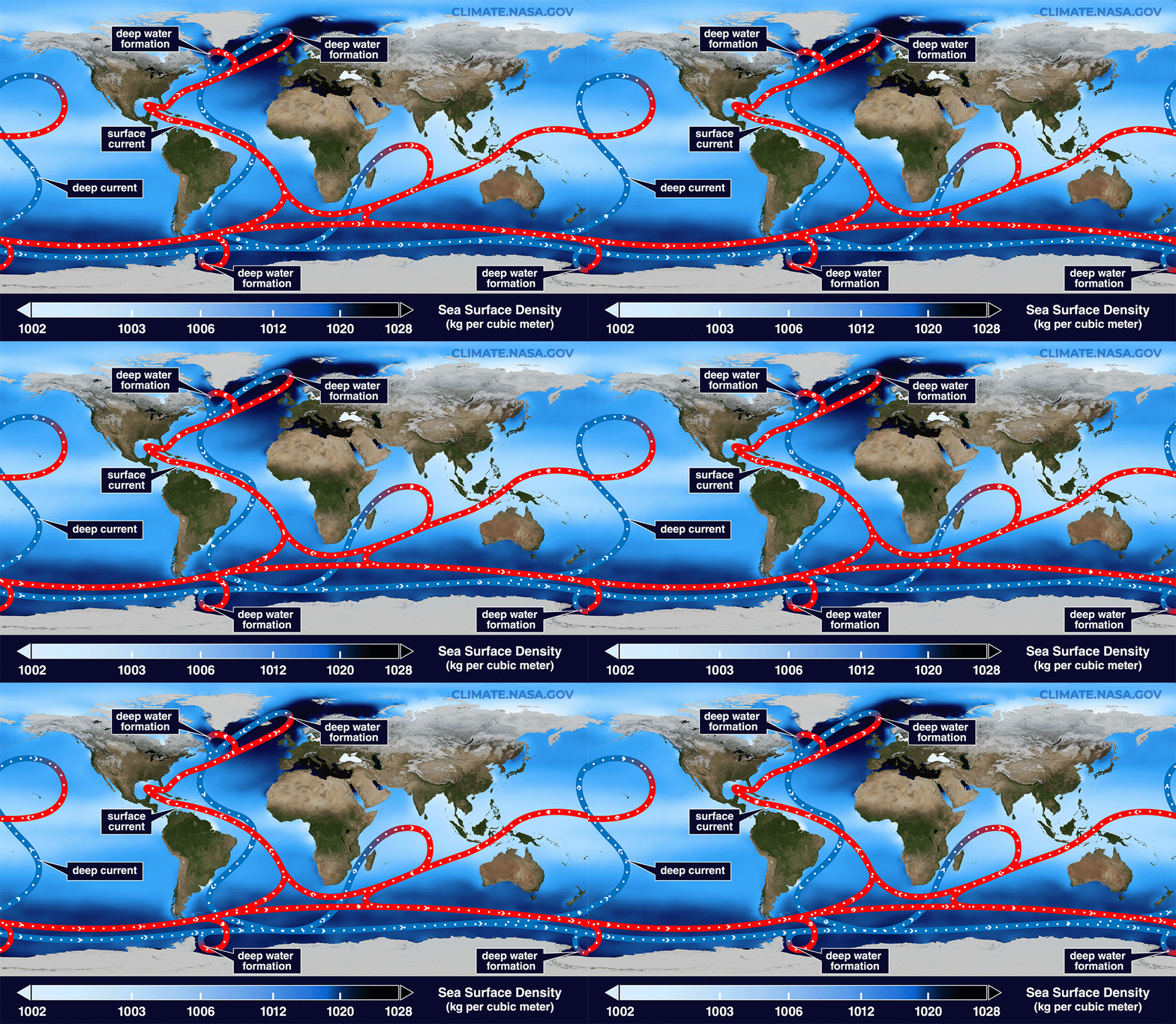
A simplified illustration of ocean currents (the global “conveyor belt”) that transport heat around Earth (Red = surface currents, Blue = deep currents). Deep water forms in areas the sea surface is the densest (background color = sea-surface density). Source: NASA
Scientists are increasingly warning that one of
Earth’s most important climate systems—the Atlantic Meridional Overturning
Circulation (AMOC)—may be far closer to collapse than previously believed.
Once considered a distant or unlikely threat, new research suggests the risk
is real, rising, and potentially unfolding within this century.
The AMOC acts like a global conveyor belt, carrying warm water north and cold
water south. This circulation helps regulate temperatures, rainfall, and
weather patterns across large parts of the world. It also includes the Gulf
Stream, the powerful surface current that brings warm water along the U.S.
East Coast and toward Europe. If the AMOC weakens, the Gulf Stream would
likely slow and lose strength, reducing the flow of heat northward and
contributing to sharper regional climate shifts—especially cooler conditions
in Europe and rising sea levels along the eastern United States. If the
broader system collapses, the effects would not be gradual—they would be
abrupt and widespread.
A recent study published in Science Advances challenges earlier climate models
that may have underestimated the system’s fragility. By combining real-world
observations with updated modeling, researchers found that the AMOC could
weaken by 42% to 58% by 2100—enough to push it toward collapse. The likelihood
of reaching that tipping point is now estimated to exceed 50%, a sharp
increase from earlier projections.
This is not just theoretical. Measurements show the AMOC has already been
weakening for decades, driven by warming oceans and an influx of freshwater
from melting ice. These changes disrupt the balance of temperature and
salinity that maintains the system's stability.
The consequences of a collapse would be severe. Europe could face much colder
winters, tropical rainfall patterns could shift—threatening food systems—and
sea levels along the U.S. East Coast could rise significantly. There are also
concerns that the oceans could lose their ability to absorb carbon,
accelerating global warming instead of slowing it.
For years, uncertainty allowed policymakers to treat AMOC collapse as a
low-probability risk. That uncertainty is shrinking. New evidence suggests
earlier models may have been overly optimistic, failing to account for how
quickly the system could reach a tipping point.
There is still debate over exactly when, or even if, a full collapse will
occur. But the overall direction is clear: the AMOC is weakening, the risks
are increasing, and the consequences would be global.
What was once seen as a remote possibility is now a credible threat within our
lifetime—and one that current responses may not be enough to prevent.
What was once seen as a remote possibility is now a
credible threat within our lifetime—and one that current responses may not be
enough to prevent.
Study: Observational constraints project a ~50% AMOC weakening by the end of this century (Science Advances, 4-15-26)
What Is the Gulf Stream? (NESDIS)
Critical Atlantic current significantly more likely to collapse than thought (The Guardian, 4-15-26)
‘Time for Half Measures Is Over’: Study Warns of Terrifying Atlantic Ocean Current Collapse (Common Dreams, 4-16-26)
A vital system of Atlantic Ocean currents is weakening and closer to collapse than thought, new studies find (CNN, 4-16-26)